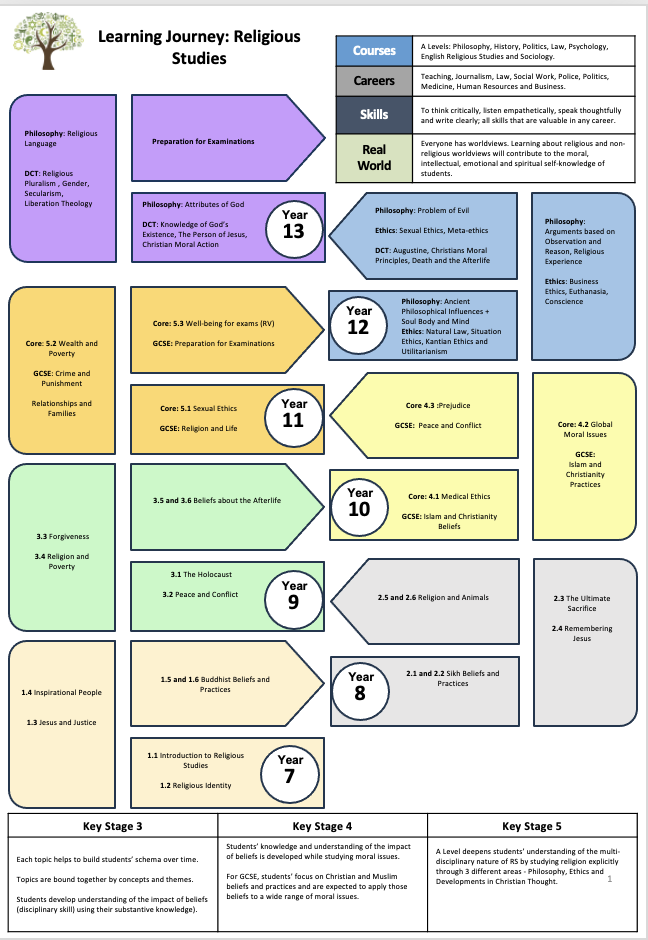
Intent
The Religious Studies curriculum at Newton Abbot College is designed to cultivate deep understanding, tolerance, and respect for religious and non-religious worldviews. It equips students with critical thinking skills, ethical reasoning and empathy, enabling them to engage thoughtfully with complex moral and philosophical questions. Through the study of major world religions and belief systems, students develop the knowledge and confidence to navigate a diverse, multicultural society and to become reflective, responsible, and informed global citizens.
Key aspects of the Religious Studies curriculum intent include:
Understanding diversity and worldviews: Developing students’ substantive knowledge of a range of religious and non-religious worldviews and enabling them to understand how beliefs and practices shape individuals, communities, and societies.
Critical thinking and ethical reasoning: Equipping students with the disciplinary skills to analyse, evaluate and articulate reasoned responses to philosophical, ethical, and moral issues, including questions of justice, peace, and responsibility.
Knowledge-rich curriculum: Delivering a carefully structured and ambitious curriculum that ensures secure knowledge of the beliefs, teachings and practices of major world religions, including Christianity, Islam, Judaism, Hinduism, Buddhism and Sikhism.
Cultural capital and personal development: Enhancing students’ cultural capital by broadening their understanding of the world, supporting personal reflection, resilience, and the ability to express their own beliefs respectfully while valuing those of others.
Coherent and sequential Learning: Ensuring learning is logically sequenced and cumulative, with effective use of retrieval practice, knowledge organisers and personal learning checklists to support long-term retention and progression over time.